
Anthony Brice
ACCA-qualified finance leader with expertise across technology, construction and professional services, helping businesses from start-up to established organisations through growth, change management, acquisitions and post-acquisition integration.

CFO Profile
Anthony is a highly experienced fractional CFO with a background spanning technology, professional services, finance and accounting, supporting SMEs and mid-market businesses through growth, transformation and change. He combines a strong technical foundation in finance with extensive commercial experience, providing flexible, board-level financial leadership tailored to the needs of ambitious businesses.
Having built his career across compliance and audit before progressing to International Finance Director within a private equity-backed technology business, Anthony brings valuable experience of operating in acquisitive, fast-paced environments. He works closely with business owners and boards to improve financial performance, strengthen governance, support strategic decision-making and help businesses navigate complex operational and organisational change.
Anthony is known for his practical, collaborative approach, helping leadership teams build stronger finance functions, deliver sustainable growth and create the financial foundations needed for long-term success.
CFO Highlights
- Extensive experience supporting technology, professional services, finance and accounting businesses, as well as SMEs and mid-market organisations.
- Background in compliance and audit, providing a strong technical foundation in accounting and regulatory requirements.
- Former International Finance Director for a private equity-backed US technology business.
- Significant experience supporting acquisitions, post-acquisition integrations and business scaling.
- Worked on the sell-side of a private equity-backed business exit, partnering with new funders throughout the transaction.
- Provides board-level financial leadership on a flexible fractional CFO basis.
- Leads business restructuring and transformation programmes.
- Strengthens governance, financial controls and compliance frameworks.
- Advises businesses on finance offshoring strategies and the development of sustainable hybrid UK and offshore finance teams.
- Mentors and develops finance teams to improve capability, confidence and long-term performance.
Case Studies
Transforming Financial Reporting to Support Growth
The Challenge
The business had experienced significant growth, but the owners lacked the financial information needed to make confident strategic decisions. Financial reporting was inconsistent, budgets were either non-existent or outdated, and there was no reliable forecasting process. The finance team was working hard, but much of their time was spent on transactional tasks rather than providing meaningful insight.
Without accurate, timely management information, the board was making key decisions without a clear understanding of financial performance or future cash requirements.
Our Approach
The engagement began with a comprehensive review of the finance function, systems and reporting processes. This fact-finding exercise identified the gaps in financial controls, reporting, forecasting and team responsibilities.
Following the review, a detailed implementation plan was developed covering both immediate improvements and longer-term recommendations.
Key initiatives included:
- Designing a finance structure capable of supporting future growth.
- Introducing a robust annual budgeting process.
- Implementing monthly management accounts with clear KPIs tailored to the business.
- Producing a comprehensive board pack, providing meaningful financial and operational insight.
- Establishing a rolling monthly forecast to improve cash flow visibility and forward planning.
- Defining reporting responsibilities and introducing documented financial processes.
- Providing one-to-one coaching and mentoring to a junior member of the finance team, enabling them to take ownership of the monthly reporting cycle.
The Outcome
Within just two months, the business had transformed its finance function.
The board now receives accurate monthly financial information, including KPI reporting, detailed board packs and an updated rolling forecast. This provides complete visibility over business performance and allows decisions to be made using reliable financial data rather than instinct.
With robust reporting in place, my role has evolved into working alongside the board as a strategic finance partner – using the management information to challenge assumptions, identify opportunities and support commercial decision-making that drives sustainable growth.
The investment in the finance team has also delivered long-term benefits. Through coaching and mentoring, the junior finance team member has developed the skills and confidence to prepare the monthly reporting independently, creating a more efficient and scalable finance function while reducing reliance on senior resource.
Improving Cash Flow Through Operational and Financial Change
The Challenge
Although the business was profitable, it was experiencing ongoing cash flow pressures that were limiting investment opportunities and creating uncertainty around future working capital requirements.
Management recognised there was a problem but lacked visibility over where cash was being tied up or which processes were contributing to the issue. They required an independent review to identify opportunities to strengthen cash flow and improve financial control.
Our Approach
The engagement began with a comprehensive fact-finding exercise to gain a thorough understanding of the business's operations, financial processes and cash flow cycle.
A detailed review was undertaken of the existing systems, finance processes and operational procedures to identify areas where cash flow could be improved. This included assessing debtor and creditor management, invoicing procedures, payment terms, reporting, forecasting and the wider order-to-cash process.
Following the review, a detailed report was presented to the management team outlining the findings, recommendations and the expected impact of each proposed improvement. Recommendations were prioritised to provide a clear roadmap for implementation.
A structured implementation plan was then developed to ensure changes could be delivered in a controlled and measurable way.
Implementation
Rather than simply providing recommendations, ongoing implementation support was delivered to ensure the agreed actions were completed successfully.
Regular meetings were held with management and key members of the team to review progress, remove barriers and hold individuals accountable for implementing the required changes. This ensured momentum was maintained and improvements became embedded within the day-to-day operation of the business.
The Outcome
The business significantly improved its visibility over cash flow and established stronger financial controls to support future growth.
Management now benefits from improved cash flow forecasting, more effective working capital management and clearer reporting to support decision-making. The new processes have created greater accountability across the business, helping to ensure that cash flow remains a key focus rather than a reactive exercise.
The business is now better positioned to fund growth, make informed commercial decisions and maintain a healthier cash position on an ongoing basis.
Key Deliverables
· Comprehensive fact-finding exercise.
· Full review of finance systems, processes and cash flow.
· Detailed management report with prioritised recommendations.
· Structured implementation plan.
· Hands-on implementation support.
· Regular accountability meetings with management.
Case Study – Supporting a Business Sale Through Financial Due Diligence
The Challenge
The shareholders were preparing the business for sale and required confidence that the financial information presented to potential buyers was accurate, robust and capable of withstanding detailed due diligence. The objective was to maximise value, minimise delays and ensure the transaction progressed efficiently.
Our Approach
The engagement began with a comprehensive review of the finance function, financial records and reporting processes. Financial models were reviewed, validated and updated to ensure they accurately reflected the performance and future prospects of the business.
Working alongside the owners and professional advisers, all due diligence information requests were coordinated and supported. Financial information was presented in a clear, consistent and commercially focused manner, enabling potential buyers to gain confidence in the quality of the business.
Implementation
Support was provided throughout the transaction process, responding to buyer queries, validating financial information and ensuring requests were addressed promptly. This reduced disruption to the management team while maintaining momentum throughout the sale process.
The Outcome
The business entered the sale process with reliable financial information and a well-prepared due diligence pack, allowing management to focus on negotiations rather than resolving information gaps. The structured approach reduced delays and helped provide confidence to all parties involved.
Key Deliverables
· Comprehensive financial due diligence support.
· Review and validation of financial models.
· Preparation of supporting financial information.
· Coordination of due diligence requests.
· Liaison with management and professional advisers.
· Support throughout the transaction process.
Case Study – Post-Acquisition Integration and 100-Day Plan
The Challenge
Following the acquisition of another business, management needed to integrate the acquired company quickly whilst maintaining business continuity. Clear ownership, financial visibility and structured delivery were essential to realise the expected benefits of the acquisition.
Our Approach
An initial fact-finding exercise was undertaken to understand both organisations, their finance functions, systems, reporting processes and operational structures.
A detailed 100-day integration plan was developed, identifying all workstreams, priorities, owners and milestones. Financial reporting, budgeting, forecasting and management information were aligned to create a consistent reporting framework across the enlarged business.
Implementation
Implementation support was provided throughout the integration period. Regular progress meetings were held with key stakeholders to monitor delivery, remove barriers and hold individuals accountable for agreed actions.
Progress against the integration plan was tracked throughout the 100-day period, ensuring milestones were achieved and any risks were identified and addressed promptly.
The Outcome
The integration was delivered in a structured and controlled manner, providing management with clear visibility over progress and ensuring accountability across the leadership team.
By the end of the 100-day programme, the businesses were operating under a consistent financial framework with aligned reporting processes, enabling management to focus on delivering the strategic objectives of the acquisition and realising the anticipated synergies.
Key Deliverables
· Financial and operational fact-finding.
· 100-day integration plan.
· Alignment of financial reporting and forecasting.
· Integration of finance systems and processes.
· Regular progress and accountability meetings.
· Tracking of milestones and delivery against the integration plan.
· Strategic support to management throughout the integration period.
More of our finance experts
Our CFOs and Finance Directors become an extension of your team—fully aligned, on your side, and committed to your success.

Irfan Mahomed
Irfan is a commercially driven, award-winning Finance Leader with 30+ years of international experience, including senior leadership roles within PE-backed, multinational and high-growth manufacturing businesses across the UK, Europe, South Africa, Asia and North America.

Adam Cox
A commercially focused CFO and global finance leader with many years of experience working across startups, scaleups, private equity-backed and established businesses within the cybersecurity, professional services and technology sectors.

Patrick Wetzels
Experienced CFO with 25+ years leading finance transformation, M&A integration and growth across PE-backed, technology and international businesses.
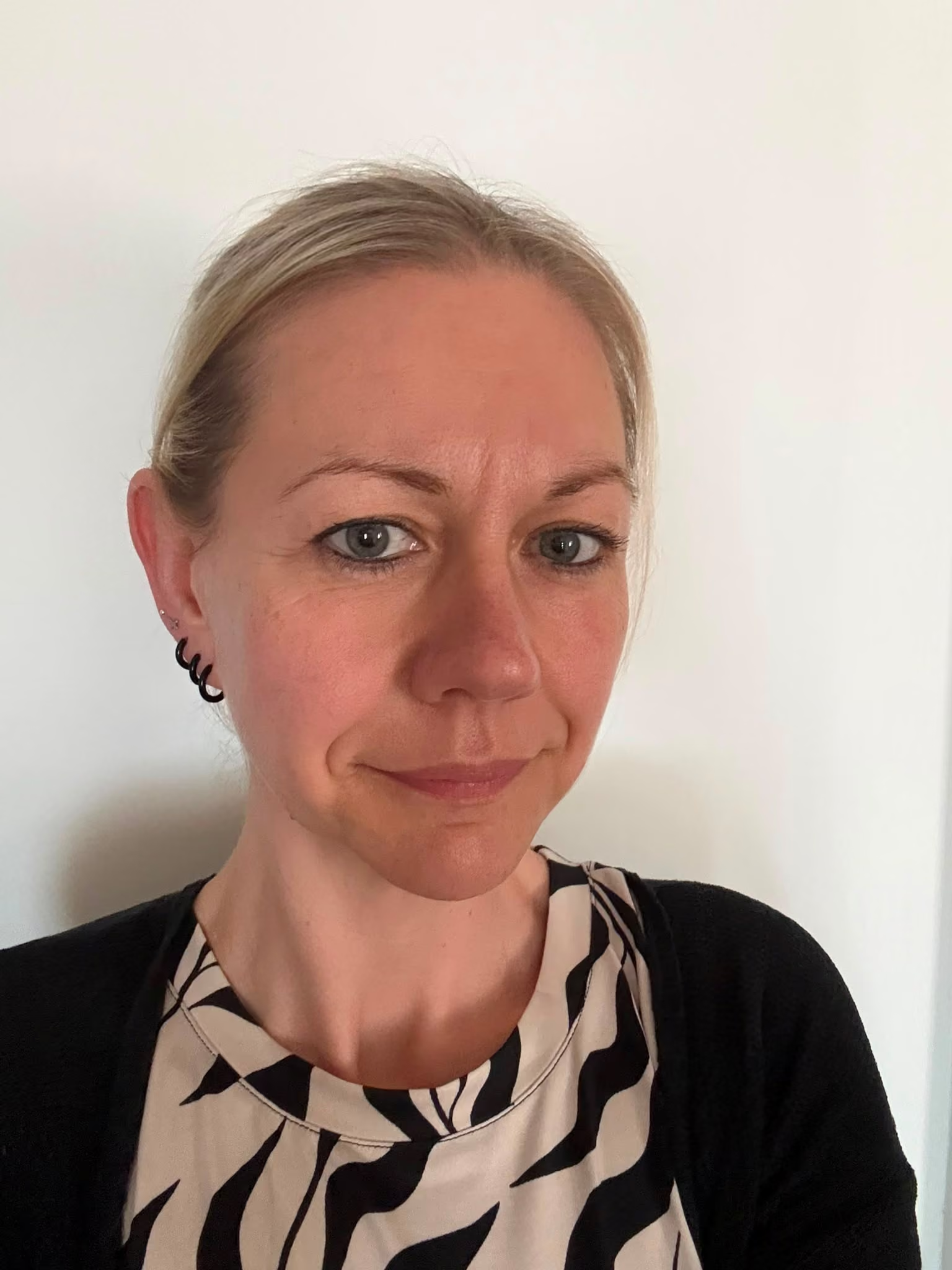
Lucy Hoye
ACA qualified Fractional CFO specialising in recruitment and professional services

Rebecca Curnock
PwC-trained fractional CFO partnering with founder-led businesses on fundraising, cashflow, financial modelling, cap table analysis and scalable finance function design.

Sas Nathar
ACA-qualified Fractional CFO helping start-ups, scale-ups and charities raise finance, transform operations and build scalable, insight-led finance functions.
Let's find the right match for your business.
View our full list of CFO & FD profiles.